Need user insight? Get the Playbook 📕
Partnerships drive success—as in many aspects of life, you can't do it alone. And you shouldn't. We've learned from over a decade of UXR experience that collaborations really do matter. One can look at the music industry for inspiration—over 40% of Billboard Top-100 hits are collaborations between two or more artists. Expanded reach, creative problem solving, credibility by association, and more are all reasons why workplace partnerships succeed.
Work smarter, not harder.
The Turbo UXR Playbook is your tactical reference 👇 guide — free to download!
Get the Playbook
Learn More
Partnering with other teams and functions is one of the lesser talked about topics in user research. It's not a hard skill, new AI tool, or plug-n-play framework. But rather a people and project strategy.
Inline with our influence-based articles—such as the how to stay resilient as a user researcher, or how to identify important transitions in UX research, and even how to effect change through UXR—this article underscores the importance of the structural support pillars within user research. And this know-how allows you to drive results in scalable, efficient, and meaningful ways.
In this article, we lay out where the UX research function sits within the organization, and why it matters so much as a connector. We'll also explain why many teams need access and insight from users to do their jobs even better. Crucially, 8 partner teams you should be prioritizing will be explained in detail, to give you a better sense for where to spread your reach and join forces.
Now, show us our future partners! 🎱
Stakeholder management UX maturity collaboration frameworks design strategy change management Human-centered design UXR-Ops teamwork Co-creation
UX Research sits within one of 3 overarching teams (generally): Product, Design, or Consumer Insights. It's then heavily matrixed into the organization, because application and implementation of user insights—across teams and projects—is the ultimate goal.
Different companies set up their org structures to fit their unique business needs. Generally, we see UX research typically fall within Product, Design, or Consumer Insights & Analytics. However, the key trait of UXR is it's almost always heavily matrixed into the organization. You may be on the UXR team, but you work directly alongside Product Managers, Designers, Engineers, Data Scientists, Marketers, and others to bring user insight to the cross-functional scrum, daily.
User insights are a currency—one that you spend across teams and functions. This process feeds human-centered innovation. Contrary to common belief, user-centered design does not happen in a vacuum. It requires expertise and application of various experts—from their respective fields—to truly innovate. They bring the subject matter expertise, and you bring the user insight and perspective.
Therefore, it's important to work closely with other partner teams. Application and implementation of user insights is the ultimate goal, not merely uncovering and synthesizing data for collection purposes. We need to see change. And change happens through others. To learn more, see our related article 9 organizational levers to implement change.
Work smarter, not harder.
The Turbo UXR Playbook is your tactical reference 👇 guide — free to download!
Get the Playbook
Learn More
To perform their function well, partner teams require quality—and timely—user insights. The behavior and mentality of the user/customer/consumer is an extremely important input, yet because of internal job specialization, most employees don't have good access.
Profitability for organizations generally coincides with growth of employee numbers, market penetration, and product variation. Depth and breadth of products spawn new teams that manage the increased scale and scope. Over time, these teams become highly specialized, experienced, and proficient at doing their focused jobs that add up to sum of the whole, which is the company excelling.
As a result, team specialization often leads to silos, firewalls, and opacity issues between them, for the sake of efficiency and privacy. And the end-user is usually part of the key process that is cut off from the teams who are producing some part of the valuable UX supply chain—be it marketing, finance, operations, product, engineering, and others.
Where small, nimble internal teams once spoke to, interviewed, and regularly interfaced with end-users through various channels... now they're relegated to powerpoints, vague videos, and folklore of who/what/how their products' end-users actually look like, think, and behave.
Realistically, most teams do require quality—and timely—insight into the end-user to perform their function well. The end user/customer/consumer are the ones who buy, use, and interact with the product of the company. They are the reason everyone ultimately has a job inside the company. Their behavior and mentality is an important input to many layers of the company's decisions.
Sadly, many internal teams crave user insight, yet don't have access. But you can change that!
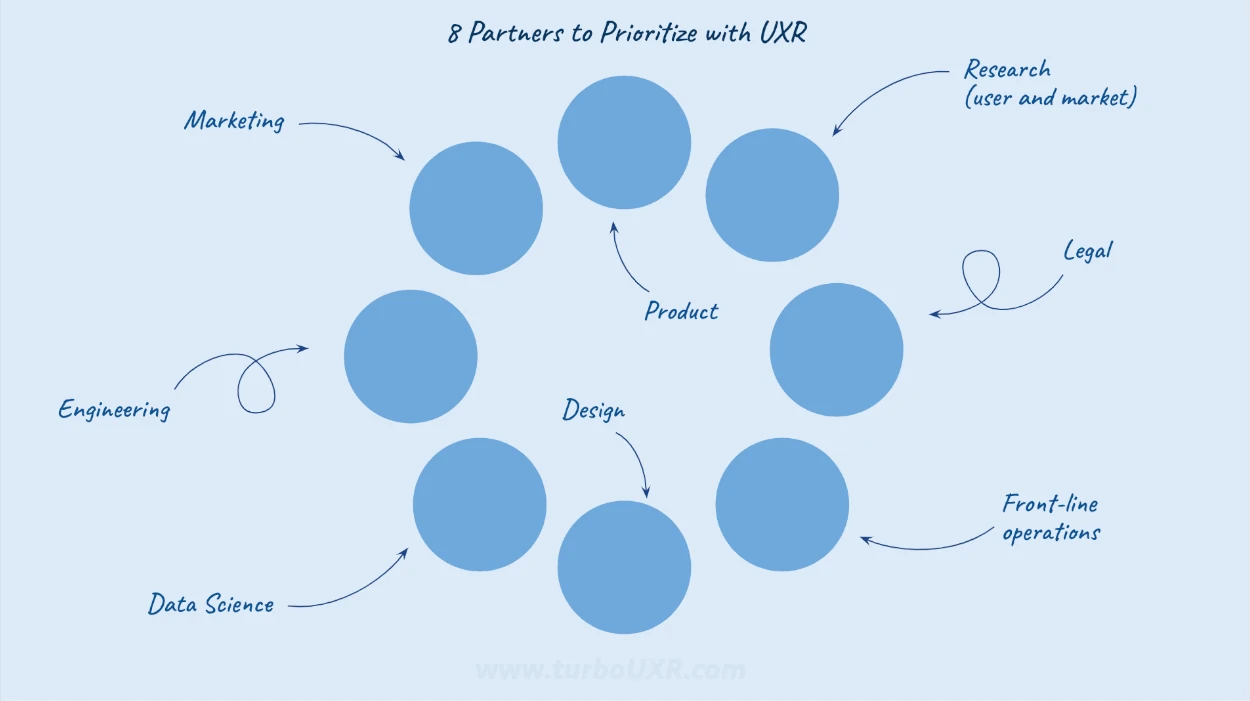
Product sets the direction for the business. They assess the needs of the market, clients, users, and business, then decide on the appropriate business strategy. Requirements are scoped, communicated, and executed against—with the the help of their partners.
Product managers (PMs) are user research's best friend. UXR empowers product leads with insight into the end user and market needs. Changing behaviors, mental models, and expected feedback by users are valuable inputs. UXR is a strategic consultant to Product—providing insight, recommendations, and feedback to help Product excel in their decisions. That's because the experience of the user is of key importance to the business (usually, but not always!).
How to engage: Attend quarterly business reviews. Ask probing questions of Product leadership. Advocate for the user—again and again. Share clear, powerful user examples. And work closely with Product Managers (PMs) in a consultative fashion. Inform their roadmaps. Explore their user curiosities. And preemetively ask, 'So, What?' (x3) of your user insights, before sharing.
Return to overview ⤴Design creates and manages the user interface and experience overall. They care deeply about ease of use, consistency, and clarity for the user. They're very familiar with today's UX and standards, and are interested in crafting what is the UX of tomorrow for the company.
Designers are closely related to UX Researchers—akin to cousins. UXR tests new design concepts iteratively, hosts workshops together with design to define the future, and brings them pain points and opportunities gleaned from regular user interviews. UXR provides insight into the user feedback—current, past, and future to help design inform their decisions. Without user feedback, design is left to make decisions that aren't user-centered, increasing the chance of product failure in the marketplace.
How to engage: Get involved in the minutia of testing new design ideas. It's helpful to understand what incremental concepts are gaining traction in the business, and work with design to bring them regular user feedback. While it's also important to help them gain strategic insight—UX personas, UX journeys, UX needs—don't forget about the "keep-the-lights-on" research needs of design. Avoid sending them away to do it all themselves. Work closely with them to build protocols, synthesize results, and explore new ideas. Then, leverage that expertise in both longer-range studies and iterative projects to knit bigger ideas together.
Return to overview ⤴Marketing is more than just advertising. Price, Product, Promotion, and Place (4P's)—not to be confused with our 4P's of User Research—are all influenced by the marketing team. They're intensely interested in who's the customer, how they behave, and how to connect with them.
Marketers are often very receptive to user research. Because of Marketing's interest in the customer, they're hungry for anecdotes, ideas, phrasing, and ways to segment with success. UXR gives tangible feedback into the lives and minds of the user, which marketing can leverage across their planning and execution process. UXR provides insight and direction, a feel for what's working vs. not, and an extra leg to lean on during ideation.
How to engage: Get to know what marketing is working on. While sometimes outputs may look similar—personas, testimonials, customer needs—the means are often different. Combine forces. Leverage their rich quant data. Tap into their user panels, and vice versa. Build off their segmentation, or add to it. Incorporate user insight in their content writing and positioning statements. Help them build something great. Be a team player. Too many times, we witness the opposite, sadly.
Return to overview ⤴Engineering is the heart of where new things are built. They plan, prioritize, and code any new experience (in a software-centered firm) that's shipped to users. They're laser-focused on new releases, bug patches, and resource optimization.
Engineers crave user insight—whether they know it, or not. While incredibly analytical in their approach, they are innately curious about who's using the experience they built, how are the users interacting with it, is it providing value, and more. This is a great avenue to blossom their curiosity and partner closely to help them improve the current-state UX, and advance the future-state UX, together.
How to engage: Start with the 1st order of business in UXR. Proactively gather feedback on what's working well already. Show engineering real users interacting with the real UX. Keep it simple. Share the basics. Share with them the good. Build rapport. Then, present the opportunities. No one wants to see all the problems upfront. Build credibility, and respect, before you enlighten them to the user pain points. Empower engineering to want to make positive changes themselves. You just provide the access to users.
Return to overview ⤴Data Science is all about understanding the past, present, and future—through data. Where have users been? What are they up to now? Can we predict future behavior? With more and more data in the world, there's endless questions and queries one can have. Data scientists are powerful in that they can show—quantitatively and objectively—what's working, and what's not.
Data scientists are blessed with user data. But often, their data is strongly quantitative, and lacks qualitative insight. They can easily point out big opportunities, outliers, and patterns, but can lack the reasoning 'why'. This makes for a powerful partnership opportunity between UXR and Data Science. UXR can qualitatively dig deep into the broad areas pointed out by data scientists to get to the root, and/or UXR can surface early signals to Data Science that they can extrapolate for statistically significant patterns among the larger data sets. A partnership made to be.
How to engage: Start small. Find an advocate in Data Science team that is interested in coupling data points (quant and qual). Alternatively, reach out to the team manager, and express your interest in building off, or leveraging their segmentation. Ask for a partner to flesh out a strategic project, or simply tap into specific data points for a tactical effort. Either way, build a relationship and get to know each other's field. Learn the pros/cons of UXR perspective, and theirs. And find ways to leverage stats more in your share outs.
Return to overview ⤴Front-line operations (Ops) teams are the voice and face of your company. Chat, phone, email, text, and in-person customer support are their main channels of interaction. They "experience" the user experience daily. And boy do they know what makes the user tick, and ticked off.
Ops team-members—like customer support/service—interact more with the end-user than anyone else in the company. They see patterns, behavioral types, and opportunities in the experience at a very granular level. They're literally in the weeds of it daily. UXR can be a great partner by leveraging their existing knowledge of the user, building off that foundation, and running new ideas past Ops as accurate stand-ins for end-users. UXR is similar to CustomerOps in that we both care about pain points, opportunities to improve, and delivering the best experience possible (mostly).
How to engage: Get to know physically where your front-line operations are. Go visit them onsite. Do tag-alongs, shadows, and observations of their user interactions. Get to know their protocols, personalities, and idiosyncrasies. Identify top-performers. Analyze why they excel. Scale those insights to others, and other channels (web, mobile, automated). Treat them like the valuable humans they are in the value-chain, and they'll reward your time and attention with droves of qual and quant insights—and memorable times to boot
Return to overview ⤴Legal teams in medium and large corporations have a variety of activities in which they're engaged. Contract negotiations, litigation, corporate governance, and risk compliance to name a few. Additionally, a critical role they serve is intellectual property—protecting, filing, and managing patents/copyrights. Because of this, they can be a key part of the innovation process. They're a team who's keenly interested in looking out for long-term strategic advantage.
Lawyers aren't who you'd think of first as a go-to partner, but that'd be a mistake. In fact, they are some of the most receptive and strategic thinking teams we've encountered at large corporations. UXR is positioned in a company to look across much of product and user experience—understanding existing competitors, customer pain points, and areas of growth. Meanwhile, legal teams have an incentive to identify novel ideas, processes, and technologies arising across the organization to patent and protect. And they'll work hard to review, refine, explore, and defend ideas that UXR brings to the table.
How to engage: Locate you are local legal team—sometimes the hardest part. Have an introductory meeting with them. Explain your interest in generating intellectual property. Ask them if they're able to do IP landscape reviews of competitors, willing to work on new IP together, and generally gauge their appetite for partnership. The ultimate goal is to build out a portfolio of new patents together. See our Project example generating new intellectual property for inspiration on how this can work.
Return to overview ⤴Research is the final core team you should seek to collaborate. Market research teams are focused on customer segmentation, statistical analysis, and quantitative surveys. They also interface in a matrix fashion with product, marketing, design, and data science—providing insight and recommendations into product positioning. And User Research is... well, we know them.
While we've found some market researchers to be eager to partner with user research, others are standoffish—same goes for UXR + UXR. There's a bit of overlap between user and market research teams, and it takes confidence and experience to work together productively. Almost like a sibling rivalry—for better or worse. You choose the relationship. The main point is, you need to find ways to stand on each other's shoulders. Research compounds other great research. Therefore, partner with your market researchers, and fellow user researchers, to build something that lasts longer than you.
How to engage: Get involved in quantitative surveys. Leverage their platforms, and insights, when it comes to quant stats. Seek to add qualitative color where possible. For example, create a collection of user video highlights underscoring their segmentation or personas. Alternatively, leverage their statistics in your presentation to drive home key points. Lastly, pick a long-term strategic project to work on together (e.g. user journeys, user needs, user personas, user panels, etc.), and stay after it quarter-by-quarter.
Return to overview ⤴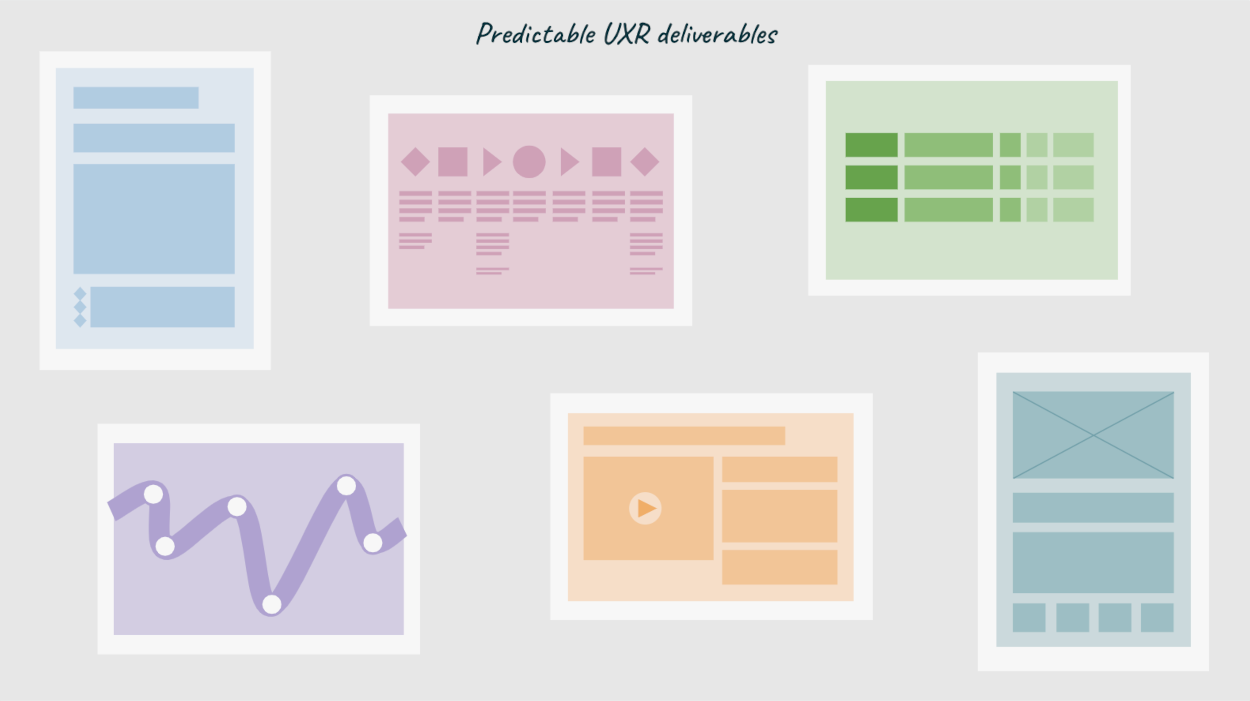
See our repository of project and process templates to expedite your user research. Various templates for project planning, execution, and communication exist to help you focus on the ends, not the means.
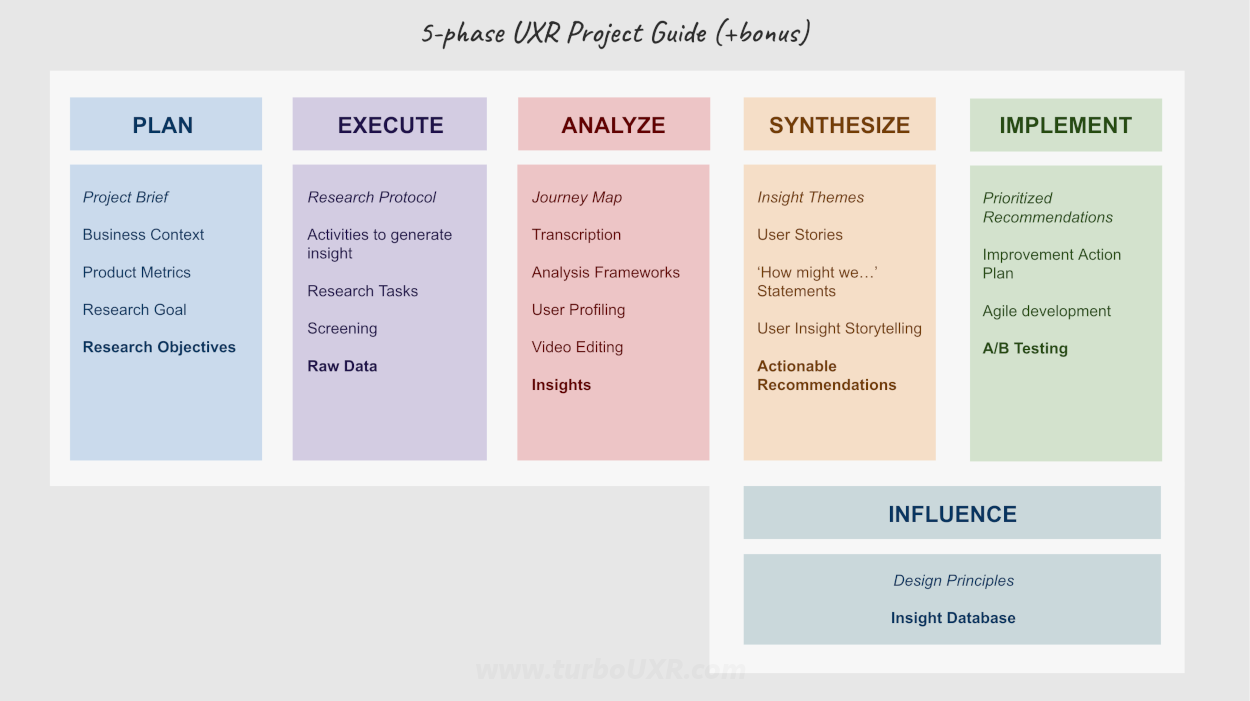
Partner decisions fall squarely within the planning phase of user research. It's a key component—in fact, it comes right after naming the project—and factors into the success and scale of your project. Choosing, and aligning partners is critical to get user insights spread across the organization. Planning good user research begins with partners, and relies on partners. So be mindful.
Back to top ⤴
Work smarter, not harder.
The Turbo UXR Playbook is your tactical reference 👇 guide — free to download!
Get the Playbook
Learn More