Need user insight? Get the Playbook 📕
Insights without action is unsustainable—for you, your research team, and the end users. To succeed in UXR, you must make a measurable impact to the actual product experience. This is done by empowering partner teams (e.g. product, engineering, design, marketing, etc.) to implement positive UX changes through their respective channels, resulting from your user insights.
Work smarter, not harder.
The Turbo UXR Playbook is your tactical reference 👇 guide — free to download!
Get the Playbook
Learn More
This process lives in the ever-so-critical implementation phase of user research. As a UX Researcher you must extend beyond simply gathering, analyzing, and communicating research insights. Because action is our friend. Until now, you've learned how to prioritize UX recommendations, followed closely by deciding how to make a UX improvement action plan. Now it's time to figure out which organizational "levers" to pull, when and how.
In this article, you'll learn which channels you have available to you, why quantifiable metrics are important to proving UXR value, and just how you can effect change through established channels.
Pro tip: diversification is key. Seek out a variety of levers to pull to be a successful UXRr. This creates a dynamic, fun, and powerful approach to your work.
Now, let's learn those levers! 🕹
Insight activation Research implementation Actionable insights Evidence-based design UXR strategy Change management User advocacy Workflow Optimization
Omni-channel user experience encompasses the users' end-to-end journey—across digital (e.g. native apps, websites, emails, text messages, etc.) and non-digital interactions (e.g. storefronts, mail, phone calls, etc.) of a product or service.
User Experience is bigger than just digital UX. If you consider the entire suite of experiences with which a product or service provides users, there's a full spectrum of interaction types and modes. Physical spaces, telephone calls, text messages, and social interactions work in conjunction—or not—with a company's digital UI (i.e desktop, mobile, native apps).
While you must research the UX across the system of interconnected channels visited by the user, you must also work with the many—sometimes disconnected—internal teams (e.g. product, design, marketing, engineering, front-line operations, digital, IVR tech teams, and other). Each of whom manage the change to their respective channel. The external user's experience spans beyond the influence of any one internal team's construct. They all contribute to the end-to-end, omni-channel user experience.
Here lies your opportunity to become a great user research team partner.
Work smarter, not harder.
The Turbo UXR Playbook is your tactical reference 👇 guide — free to download!
Get the Playbook
Learn More
UX Researchers show value through the quality (i.e. reputation), quantity (i.e. throughput), and measurable impacts (e.g. increases in #'s, %'s, etc.) of user insights delivered.
Pro tip: Start with metrics in mind during the initial project scoping phase, to be able to quantify at the end.
UX Researchers are recognized for the value they contribute in three main ways: 1) The quality of their work as measured by "internal" NPS (Net Promoter Score), 2) the quantity of work, as measured by the throughput of projects delivered, and 3) the impact of their work, as measured by objective business metrics (%, !, @, #, etc.). While some companies may heavily weigh one more than another, ultimately, researchers must deliver on all 3 merits to avoid intense scrutiny (i.e. job loss).
First and foremost, having a high "ease of doing business" is incredibly important for UX researchers to perceived by partner teams. Some examples include: being open to new projects, eager to engage, aligned with the company business model, and capable of uncovering useful user insights. These are key to how teams perceive the collaboration with UXR.
Your "internal" Net Promoter Score (i.e. how highly do your partner teams recommend your work to other internal teams), is a good measure of success. You want to regularly be in the 9/10 category... highly recommended by IC's, managers, and leaders within product, design, engineering, and more—who leverage your insights openly, and often. Ways to avoid ratings of average and below average include, not being: overly academic, pretentious, hard to find, difficult to understand, of irrelevant focus, etc.
Second, quantity of projects and user insights is necessary for success. UX researchers need to balance multiple projects, of short-term (i.e. evaluative) and long-term (i.e. generative) perspective. This gives researchers a bifocal lens of what's meaningful right now, and also what we should be looking out for in the future (user behaviors and perceptions). Keeping frequent projects scoped tightly, moving forward, and concurrently aid the ongoing supply of user insights to the organization. Over time, projects and insights compound. This increases efficiencies and influence.
Third, measurable changes to the end user experience must be quantifiable. Your insights must be tied directly to an increase in user engagement, sales, cost-savings, user base growth, satisfaction, and more. Pick the metrics most valued by your business and type of organization, and learn how to move the needle.
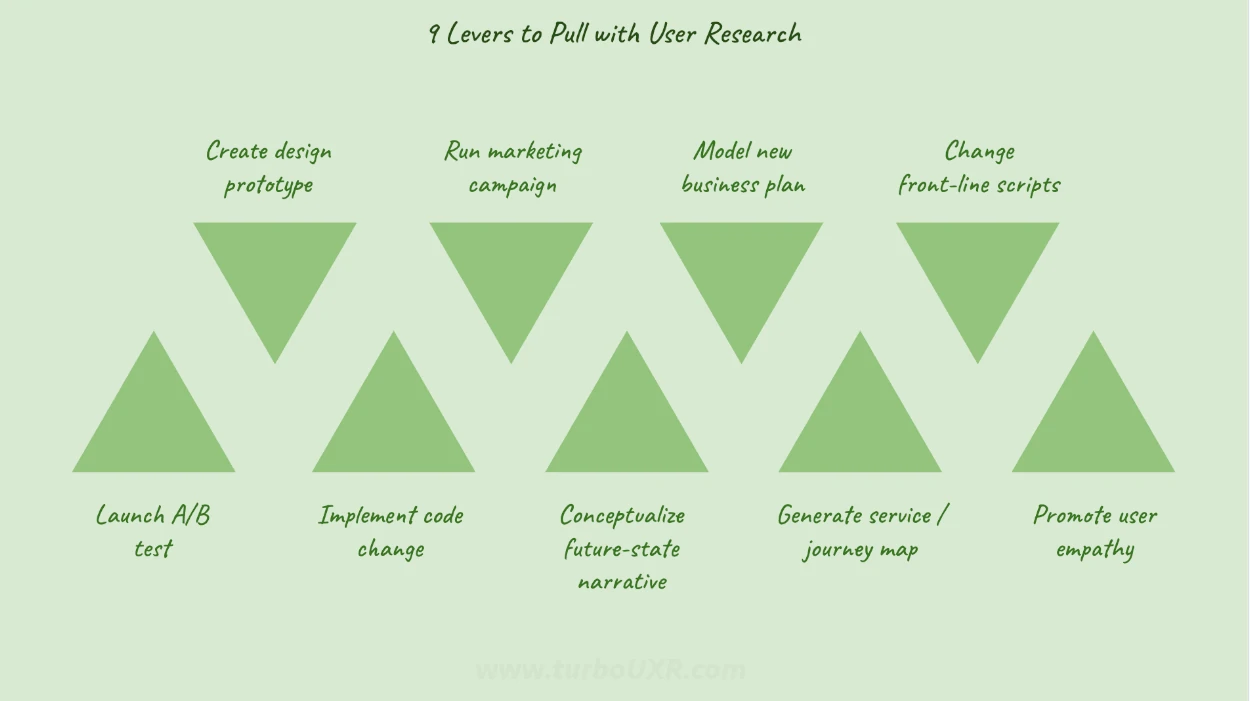
Effecting change in any organization comes down to how many "at-bats" you have. Required inputs include time, experience, expertise, skill, access to users, and more. Whereas, outputs are the place you score "hits".
Focus on variety of artifacts, partnerships, and channels to implement your user insights into the company. Listed are examples of levers we've found success in pulling, to get points on the UXR board.
Launch an A/B test to put user insights to the test in a scientific and safe (risk-mitigated) manner.
A/B tests are a great way to put user insights to the test in a scientific and safe (risk-mitigated) manner. The benefit of a well-designed A/B test is that all it requires is an informed hypothesis. No need to scale, or be certain at this stage.
Find a partner who controls some sort of outlet (e.g. email campaigns, website landing page, IVR scripts, conversion CTA, etc.), and put your user insights to the test. Create 2 variations based on user-feedback and ideation, ensure you have great metric tracking implemented (i.e. Google Analytics, HotJar, etc.), and see which variant proves more valuable.
We find A/B tests to be the perfect mixture or research, strategy, and implementation all in one. Make sure to let the data inform decision-making about next steps. All the better if you can schedule iterative tests that flesh out many aspects in detail over time. Since the tests often require set up, it's best to scale the practice to develop efficiencies, instead of a one-and-done approach.
Return to overview ⤴Create a design prototype to push the envelope, spur user conversations further, and encourage new ideas (mild to wild).
Design and research go hand-in-hand like peas in a pod. Product designers are typical partners for most UX Research projects these days. Especially, when the product/service is a digital UI experience. Therefore, informing and encouraging new design prototypes is a great way to implement user insights.
Facilitate workshops and working sessions that get everyone to sketch out future-state ideas based on user feedback. Better yet, take those prototypes into ongoing user interview sessions (alongside designers) to spur conversations even further. Seek to develop a wide range of design prototypes—working and not. Mild to wild. Near-term design prototypes are great to flesh out upcoming changes and ideas. Whereas long-term design prototypes help to get the more exciting ideas out on the table. Temporarily suspending technical and financial constrains are a good way to push the envelope to the max.
Partner closely with a designer to work on a series of prototypes. Or pick up a pen, paper, or the latest AI tool to produce some concepts yourself.
Return to overview ⤴Implement code change(s) to ship practical, pragmatic tweaks that can be implemented quickly.
Shipping new code is what really matters across many industries, especially digital/tech companies. The beauty is the UX can change with a push of a button. This is a powerful lever with which to be connected.
Software engineering teams are hungry for user insight. While they're not the typical drivers—or receivers—of UXR projects, you can change this. Find your closest front- and back-end engineers and parter with their team. As a UXRr, show up to their team syncs. Get to know their technical interests and influences. Provide them with regular user feedback about the product.
Start working with engineers to implement code changes based on user insights. Their user knowledge and partnership will increase this relationship. This is a fast way to make change happen based on user insight. BUT, it requires upfront relationship building, ongoing user feedback with engineering interests in mind, and a focus on the very much NOW version of the UI/UX. Engineers typically will not be interested in far out ideas, but rather practical, pragmatic tweaks that can be implemented quickly.
Return to overview ⤴Run marketing campaign(s) to influence messaging across email, print, social media, advertisements, and more.
Marketing teams have the unique ability to be both strategic and tactical. The leaders often operate at a high-level within an organization, and those who work for them execute marketing campaigns that directly touch the consumer. This makes them a great candidate for partnering to execute on user insights. They're receptive, and in need of user insight to inform decision making at all levels.
Learn what's in scope for your closest marketing partner. Email campaigns, physical mailings, social media channels, online advertising campaigns, and more are great outlets to test user insights. These channels need new ideas, ways to connect with users, behavioral predictions, and new messaging that can be generated from user interviews/analysis. Host brainstorming sessions for their materials, based on user profiles, insights, and journeys.
Additionally, marketing teams often have research channels of their own. Consumer panels, market researchers, and rich historical data. All of which makes them a great partner for teaming up!
Return to overview ⤴Conceptualize the future-state narrative to visualize and circulate the vision-state UX narrative within the company.
If there's one thing that's often lacking in companies, it's a visual and narrative depiction of the user experience in a realistic future. We're not talking way down the road, but 1–2 steps ahead. These are often conjured with fluffy words, and bad graphics. Here's your opportunity to regularly illustrate what the future UX could look like.
Start with the narrative / story. How might the user experience change based on what we've learned of the user? What would be a more valuable journey? Incorporate user feedback on digital channel preference (i.e. mobile, web, voice), more seamless integrations of existing touchpoints, and desired outcomes framed from the user perspective—not the company's or product's.
Think of yourself like an external consultant. What new ideas can we propose? What user pain / gains can we illustrate in story fashion? Tie it all together, and work with creative teams to visualize and circulate the vision-state narrative within the company.
Return to overview ⤴Model new business plan(s) to instigate new interaction models for how users engage with the product/service ecosystem.
Business models aren't just for PMs (Product Managers). Getting to know how the company makes money is everyone's job. Understanding your current model generates alignment and creates focus for ideation. Plus, they're a great outlet for applying user insight and challenging status quos.
Explore the creation of new business models based on user insights. Use the Business Model Canvas to detail out how new ideas might work. Leverage the 10 Types of Innovation to spur ideas of different business models (e.g. Subscription Model, Retailer Model, Product-as-a-Service (PaaS), Franchise Model, Affiliate Model, etc.). Challenge how your user navigates the experience in these new forms of interaction.
Think big. Imagine you're upsetting the industry as a new player. Don't let current constructs limit ideation. Really re-think how the UX could look different if the product/service made money in a new way. Visualize the experience. Create new narratives based on this business model ideation. Circulate internally and spur new thinking among adjacent teams.
Return to overview ⤴Generate service / journey map(s) to create knowledge that empowers partner teams to comprehend, assess, and take action.
Service blueprints and journey maps spell out the user experience in plain detail. They make all the unknowns known, and shine a bright light on all touchpoints—both visible and invisible ones. The beauty of mapping the UX, is it allows everyone to level up their knowledge. Conversations can be grounded in reality. Assumptions waived. On top of which, informed decisions can take place.
Start simple. Nail down the basics of the front-of-house operations/interfaces with which the user comes in contact. Then move onto the transactions, back-of-house, and ultimately partnerships that underpin the supply chain. Add supporting visuals, quantitative data, user quotes, and highlights that bring the maps to life. Encourage sharing, adding upon, and bringing into user and leader sessions alike. All will make it even more powerful.
Consider this a knowledge creator / broadcaster. While no particular outlet will be guaranteed to change, these maps have the power to influence many channels, over time. The knowledge will live on to empower many partner teams to understand, assess accordingly, and change the respective UX. Lastly, make sure to track any UX changes along the way, to maintain a "living" document.
Return to overview ⤴Change front-line scripts to positively influence the voice of the company (phone and chat agents, both automated and non–).
Phone and chat agents, both automated and non–, are the voice of your company. They leverage scripts and protocols for how to interact with the user. What to say, when, in what tone, etc. These are a great target for change when considering improvements to the overall user experience. While less "visible" than a GUI, front-line agent scripts are very impactful to the overall UX.
Spend time to learn the scripting ecosystem. Make changes, propose ideas, and test new approaches. The benefit is these can be altered quickly and in MVP (minimal viable product) fashion. When success if found, simply scale the changes to all agents or interactions, and continue onward. Think of it as a prime A/B testing grounds for small, targeted changes that compound.
Important! Don't forget about the humans who deliver these messages. Many times, call centers are still at the heart of the delivery mechanism. Take a trip to them. Meet the agents. Get to understand what motivates and incentivizes them. Take all this into consideration when crafting new script(s). Since they will be the ones who make or break the new ideas/changes, make sure to get their buy-in. Involve them in the ideation phase to leverage their unique experience and perspective.
Return to overview ⤴Promote user empathy to build awareness for: who we serve, how they behave, and what can be improved.
Last, but not least, promote user empathy. Empathy and understanding for the user behavior(s), mental model(s), and context is not generally top-of-mind within the organization. Finance, business, sales, data science, engineering, design, and other teams are often disassociated from the user. Promoting awareness for who we serve, and what they look like (metaphorically) is paramount.
Create highlight videos. Generate user personas. Advocate for the user needs in meetings. Pull together presentations, lunch-n-learns, landing pages, and more that showcase the user. Make it digestible, repetitive, and engaging. Become the go-to source for user behaviors, mindsets, and archetypes.
Consider this a constant work in progress. Not only are your trying to get work done through others in terms of levers pulled, but education of your teammates about the user is part of the journey. Often times, you won't have all the answers as to what should change. But, your project mates may have grand new ideas as a result of just getting closer to the user.
Return to overview ⤴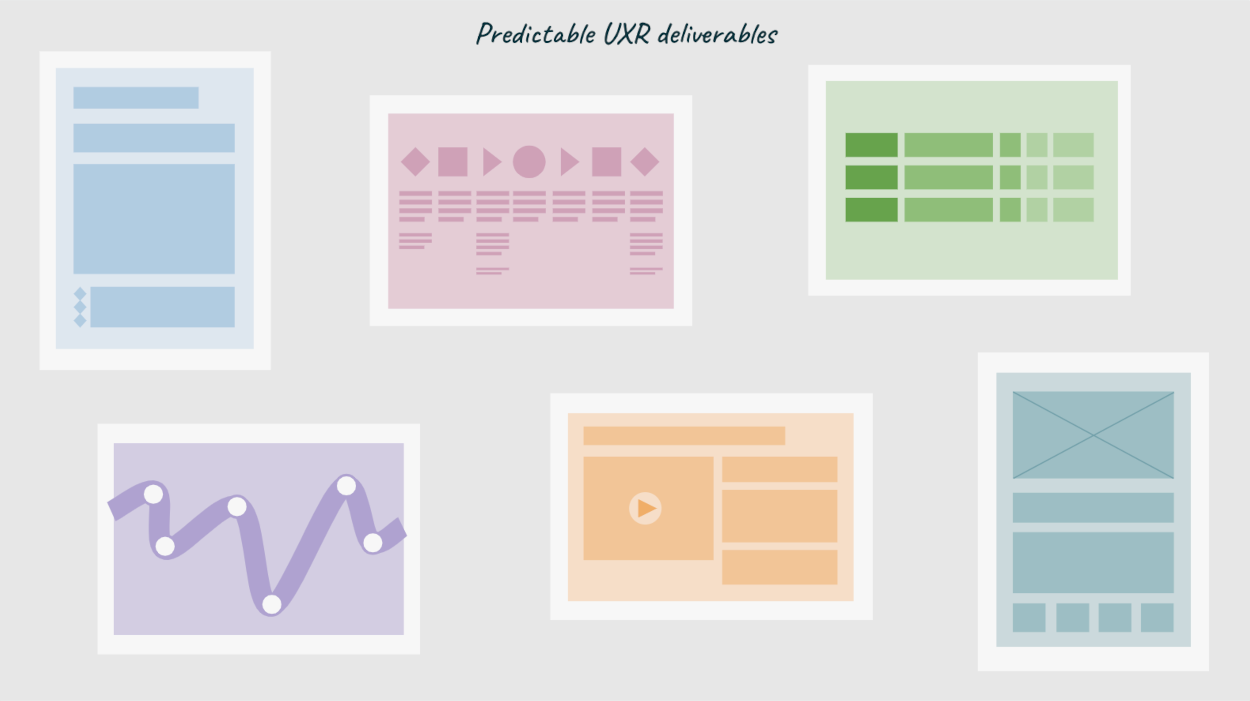
Looking for quick-reference templates to get your UXR projects started? Check out our free UX research templates to get going quickly. Guides available for project planning, execution, synthesizing, influencing and more.
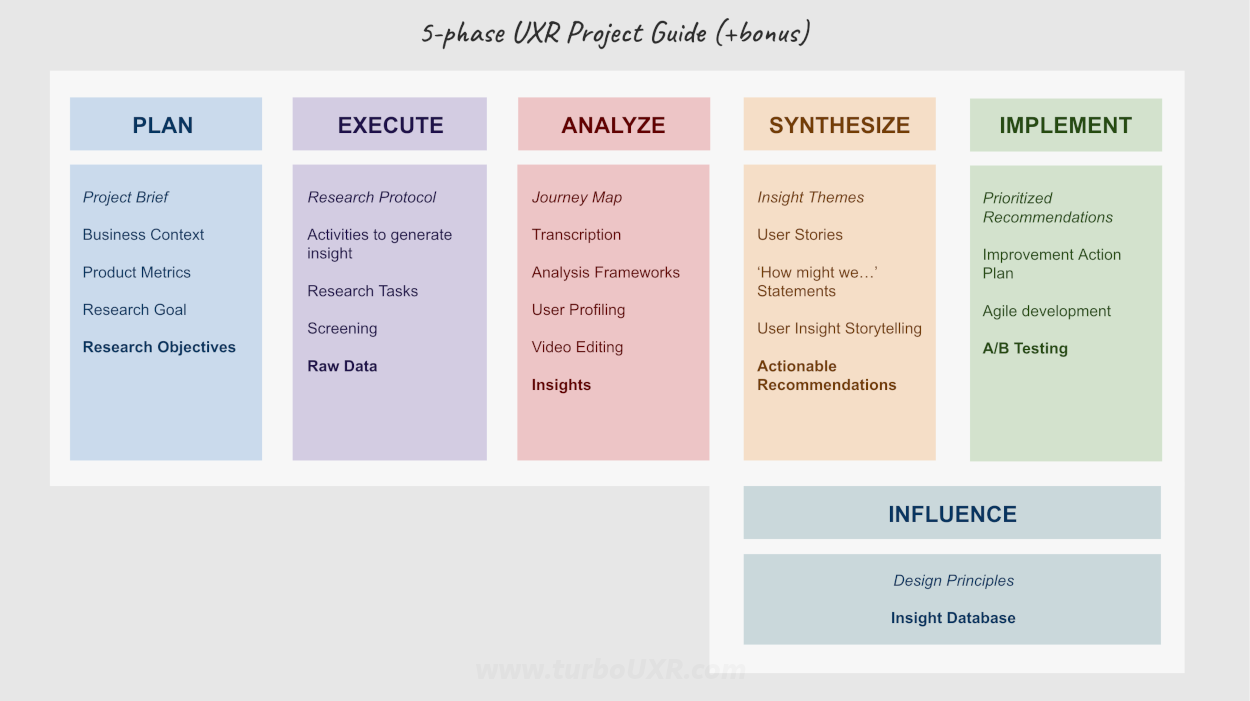
9 Levers fits within the execution phase of user research. It's all about getting *it done. It's the time to bring to life numerous ideas uncovered throughout the research process. Think of yourself like a program manager for user improvements. Identify which cross-cutting opportunities exist, and get to work organizationally to make change happen.
Back to top ⤴
Work smarter, not harder.
The Turbo UXR Playbook is your tactical reference 👇 guide — free to download!
Get the Playbook
Learn More